
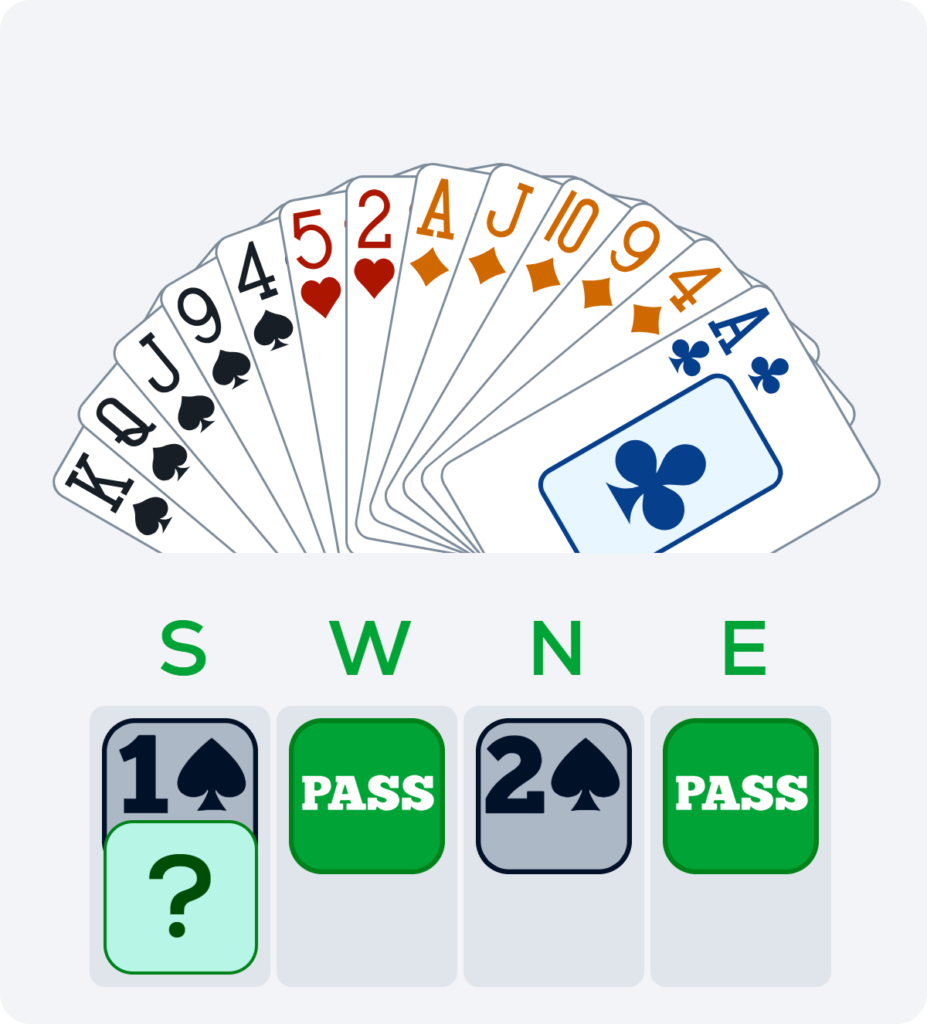
Exercise: what rebid over 2♠?


Colin Deheeger
It’s your turn. Which bid will you choose?
Colin Deheeger‘s solution
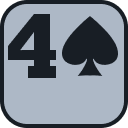
This is the contract you want to play in. Indeed, it is impossible to make slam because partner has at most 10 points. The ace of spades and king-queen of diamonds are the maximum they could have. Hoping for a singleton heart on top of that would be too optimistic, as that would mean that the opponents have 10 cards in hearts and have not shown them.
Signing off in 4♠ and allowing some uncertainty to remain about your hand seems to be the best option.
Score: 20/20 ✅
This is a good option as it gives partner a good idea of your hand. However, you must force to game with this hand. So, if you bid 3♦, it is with the intention of saying 4♠ afterwards (which is why 4♠ directly deserves 20/20, as here you will have just given more information to the defending side). A good mnemonic to know whether to force or invite to game with 5-5 in this sequence is to count your losers. If you have 7, pass; 6, invite; 5, force.
Score: 15/20

In the same vein as 3♦, there is no point in asking partner to describe their hand. Moreover, by bidding 2NT, you are promising a fairly balanced hand. The only reason why the bid is shown in the responses is because it is still a way of giving partner a chance to show their heart shortage. Note that by saying 3♦, they can also do this and will be able to assess the rest of their hand.
Score: 10/20

There are several reasons why 4♣ is a bad bid. First, you avoid splinters with bare high honours. Furthermore, once again, as no slam is possible, you should not describe your hand. Here, by bidding 4♣, you could encourage the opponents to lead a trump, which could be the most troublesome lead if partner has a singleton diamond.
Score: 5/20

There are far too many potential tricks to pass 2♠. Furthermore, the opponents could find their fit if you pass, thus disrupting us in the sequence. If partner only has king-queen of diamonds (5 points), you make game. It is therefore unreasonable to pass with so few losers.

As for 4♦, contrary to what one might think, 4♦ does not show a strong 5-5. It is a splinter bid (like 4♣).
If you have an even stronger hand, you can say 3♦ and then use cue bids or bid Blackwood.
What did you think of Colin’s question?
Share your view and score in the comments!

I also would have bid, 4 Spades! Interesting!
The best bid
I would have bid 3 spades: partner will pass with a minimum support or bid 4 with a max (9 or 10]
But our hand is v strong (5 losing tricks).
I would also bid 3 space. If partner has maximum he bids 4; if not 3 is ok
Yes I think so also
I would have bid 4 spades since the card distribution was provoking.
4 spades as it is a strong hand with few looser
I haven’t played Bridge for some time, just returned from a longer break… glad I am still remembering my fine-tuned bidding system. Now that I can play DONT (Disturbing Opponent’s NT) on Funbridge, I changed from Multi-Landy to DONT for the one- and two-suiter overcalls against 1NT.
For this lesson, my bid would have been 3D, and I’m glad it’s at least the second-best answer… so I haven’t forgot how to play Bridge
4s is what I would bid
4 spades
With 15 HCP, and some extra distribution points it has to be a 4 ♠️ rebid. You know you definitely have game going points (counting your distribution points also) so why give the opponents any more information. 4 ♠️ is an easy contract and if you get plus 1, then all the better ♂️
4 pics