

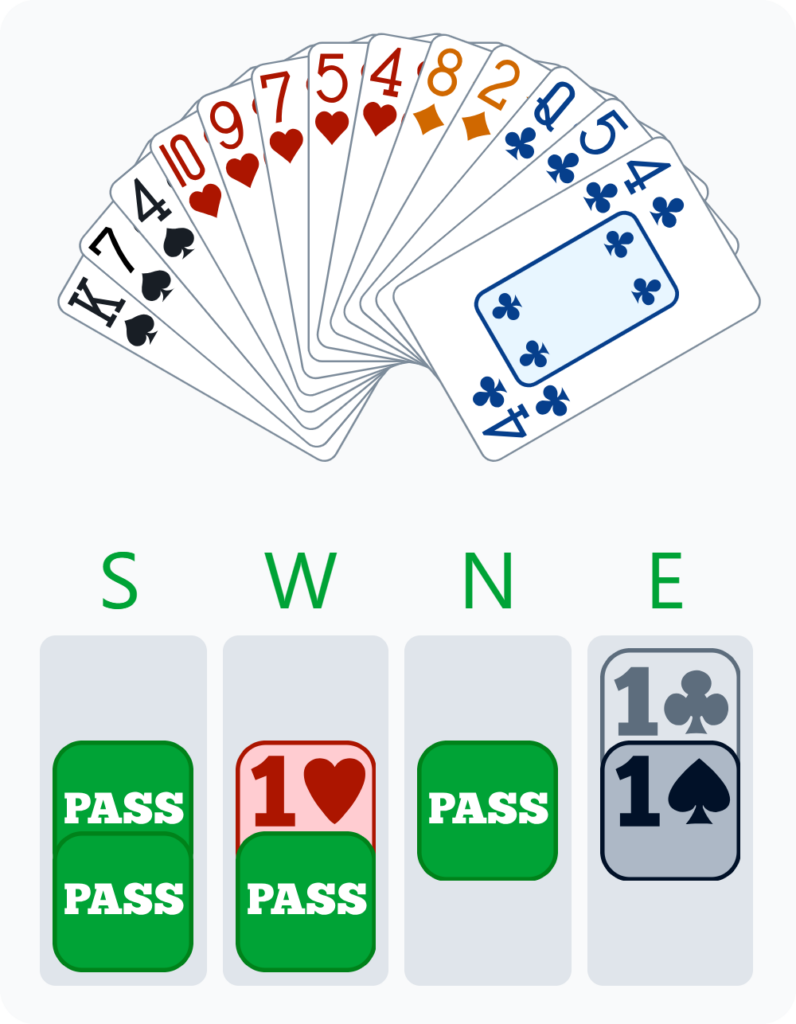
Part 1: the 1♣ – 1♥ – 1♠ sequence


by Michel Bessis & Philippe Cronier
Summary
Passing
Supporting one of the opener’s suits
Support in clubs
Rebidding your response suit
Bidding NT
1NT, the universal catch-all bid
Practical exercises
The sequence studied today is undoubtedly one of the most frequently used in uncontested auctions. It is also one of the most imprecise: by saying 1♠, the opener may have anywhere from 12 to 19 points, and their distribution varies from a modest 4-3-3-3 to huge two-suited hands. It is therefore essential to precisely determine the meaning of the bids that will follow. The purpose of this first article is to explain the responder’s actions when they have an insufficient hand to force to game opposite a minimum opening bid.
As responder, bidding with a weak or average hand is by no means synonymous with stopping. Indeed, if the opener has a really strong hand, nothing will prevent them from bidding again.
Furthermore, the responder has many options. They can support the opener in one of their two suits with a fit of at least four cards. They can also repeat their own suit or bid NT. And finally, unlike the popular belief that the 1♠ bid is forcing, they can also pass.
Passing
When the 1♠ contract seems more or less satisfactory and no reasonable alternative is possible, passing allows you to stay within the side’s safety margin.
You need a Funbridge Premium+ subscription to keep reading.
Only the Premium + subscribers can read this article.



Thanks for the great article. So many partnerships don’t discuss the meanings of these low level bids. I prefer to bid 1nt when I’m balanced rather than bid a 4 card major…so I will only bid the major when I’m unbalanced.
Very precise very helpful