Discovering bridge
Bridge is probably the best card game in the world. Even if the rules seem to be complicated, they are not particularly and it will take you a few minutes only to grasp them. And that is precisely the purpose of this module.
Bridge is played with four players sitting at a card table: they are often named after cardinal points (North, South, East and West). The two players across from each other are partners: therefore the North-South side always plays against the East-West side. On Funbridge, you will always be sitting in South for the sake of simplicity.
Bridge is played with four players sitting at a card table: they are often named after cardinal points (North, South, East and West). The two players across from each other are partners: therefore the North-South side always plays against the East-West side. On Funbridge, you will always be sitting in South for the sake of simplicity.
The cards in bridge:
Bridge is played with a deck of 52 cards. All cards are dealt one at a time in a clockwise rotation. Each player thus receives a hand consisting of 13 cards.
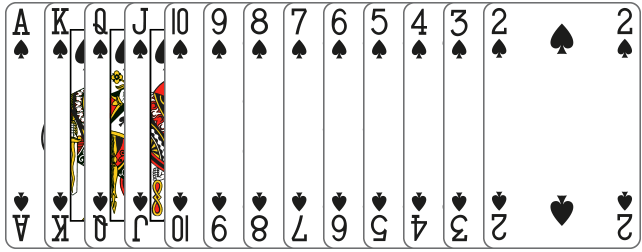
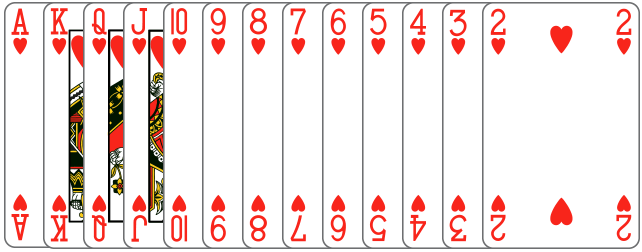
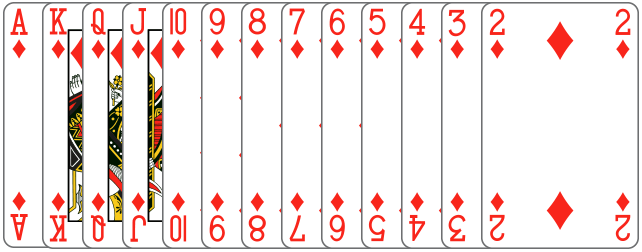
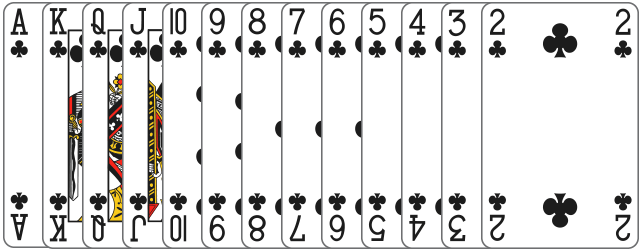
The highest-ranking card is the ace followed by the king, queen, jack, 10, 9 and so on up to 2.
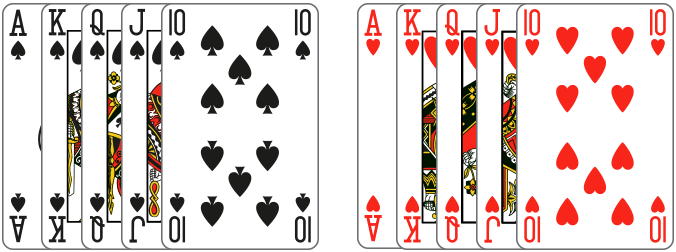
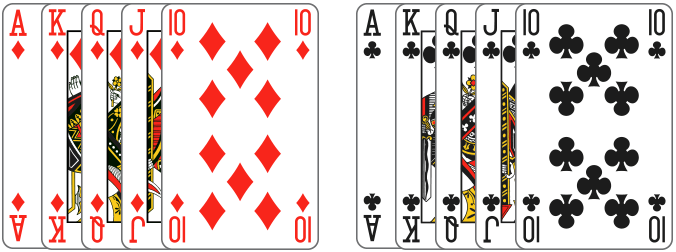
The highest cards in each of the four suits (spades, hearts, diamonds and clubs) are called honours.
There are 5: ace, king, queen, jack and 10.
The highest cards in each of the four suits (spades, hearts, diamonds and clubs) are called honours.
There are 5: ace, king, queen, jack and 10.
The play:
Each player places a card on the table in turn. When each of them has played a card, the four cards are collected. This is called a trick.
The one who places the highest card wins the trick (the four cards) and plays the card of his choice to the next one.
13 tricks will follow, the aim for each side being to take as many as possible.
The one who places the highest card wins the trick (the four cards) and plays the card of his choice to the next one.
13 tricks will follow, the aim for each side being to take as many as possible.
When you play your cards, you have to follow two rules only:
- You play in turn in a clockwise rotation.
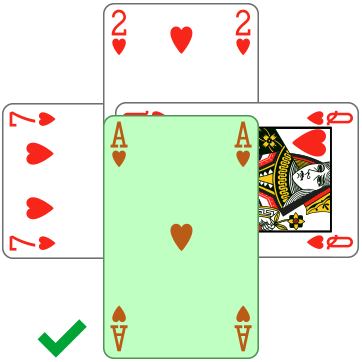
- You have to follow suit, i.e. place a card of the same suit as the one led when possible (if you hold such cards).
- You play in turn in a clockwise rotation.
- You have to follow suit, i.e. place a card of the same suit as the one led when possible (if you hold such cards).
Further details:
You are not obliged to play a higher card than the one played by the opponent.
Each trick has the same value and the cards of the trick don't change the latter.
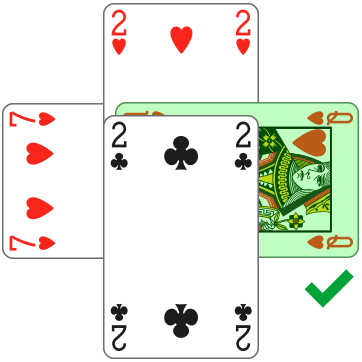
If you can't follow suit, you "discard". In that case, you won't be able to take the trick even if you place a higher-ranking card.
Each trick has the same value and the cards of the trick don't change the latter.
If you can't follow suit, you "discard". In that case, you won't be able to take the trick even if you place a higher-ranking card.
The choice of the contract:
Via a process called "the auction" that will be explained later, one pair (often the one with the highest number of points) first contracts to make a minimum number of tricks. Logically, you have to contract to take more tricks than the opponent, i.e. at least 7.
In bridge, by making this bet, you "name a contract" and the player who does so is called the "declarer". There are 7 contracts: 1NT (read "1 notrump", which is the bet to take 7 tricks), 2NT (8 tricks), 3NT (9 tricks), 4NT (10 tricks), 5NT (11 tricks), 6NT (12 tricks), 7NT (13 tricks, i.e. all tricks!).
In bridge, by making this bet, you "name a contract" and the player who does so is called the "declarer". There are 7 contracts: 1NT (read "1 notrump", which is the bet to take 7 tricks), 2NT (8 tricks), 3NT (9 tricks), 4NT (10 tricks), 5NT (11 tricks), 6NT (12 tricks), 7NT (13 tricks, i.e. all tricks!).

For instance, South can bet with his partner that they will take at least 9 tricks out of 13: he will thus become the declarer in the contract of 3NT. Once the contract is decided, the player to the left of the declarer places the card of his choice on the table: he "makes the opening lead".
The declarer's partner then places his hand face up on the table. He is the "dummy" and at this point, he becomes an observer since his partner, the declarer, will now play his cards on the whole deal. Therefore the declarer plays a dummy's card, then it is the turn of the player to the right and finally, the declarer is the last one to play.
If the dummy takes the trick, the declarer plays a dummy's card again to the next trick.
The declarer's partner then places his hand face up on the table. He is the "dummy" and at this point, he becomes an observer since his partner, the declarer, will now play his cards on the whole deal. Therefore the declarer plays a dummy's card, then it is the turn of the player to the right and finally, the declarer is the last one to play.
If the dummy takes the trick, the declarer plays a dummy's card again to the next trick.
The opening lead rules:
You should lead your longest suit. Indeed, by playing several times in that suit, in the end you will be the only one holding cards in it and you will be able to win tricks even with very small cards.
How this module works:
For each chapter, there is an introduction covering the concepts that are detailed in it. Then you will play 8 deals with comments and tips to help you assimilate them. Finally, you will play one or several deals on your own.
Don't worry if some concepts seem a bit difficult to you. You can go back over them as often as necessary.
Now you know enough you to start your first game.
Don't worry if some concepts seem a bit difficult to you. You can go back over them as often as necessary.
Now you know enough you to start your first game.