The opening
In bridge, though it is quite rare, you can find that you have a game-going hand by yourself even if your partner doesn't have the 5-6 points that are necessary to respond.
There is a particular bid for these extraordinary hands: the
This doesn't promise anything about : you will find out more about the distribution in the second step. Partner will always have to respond
There is a particular bid for these extraordinary hands: the
opening, also called game-forcing
.
This doesn't promise anything about : you will find out more about the distribution in the second step. Partner will always have to respond
over this opening and opener can then show his distribution.
With a balanced hand
You will need at least 23 HCP and you will, of course, bid
over the
response.
With a single-suited hand
To open
This means that you will have to take at least 9 tricks in a major and at least 10 in a minor. You are, of course, allowed to take more tricks than these minimum requirements.
Moreover, your hand has to include a few defensive values. 16-17 points is the minimum number of HCP necessary for such an opening.
, you will need the minimum for game minus 1 trick.
This means that you will have to take at least 9 tricks in a major and at least 10 in a minor. You are, of course, allowed to take more tricks than these minimum requirements.
Moreover, your hand has to include a few defensive values. 16-17 points is the minimum number of HCP necessary for such an opening.
Three examples:
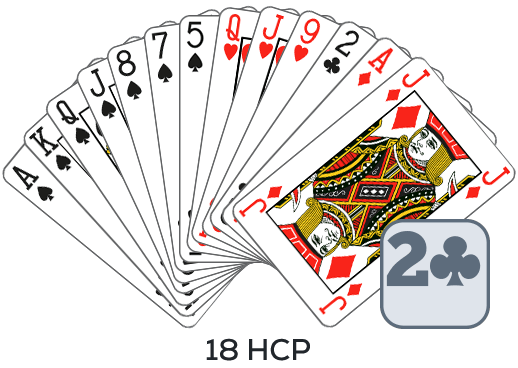
9 playing tricks with Spades as trumps (7 1 1). You will therefore open
.
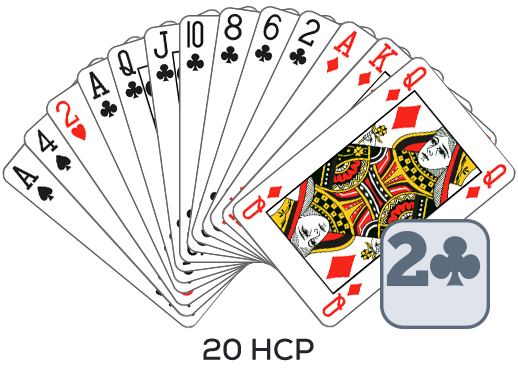
10 playing tricks with Clubs as trumps (6 1 3). You will therefore open
.
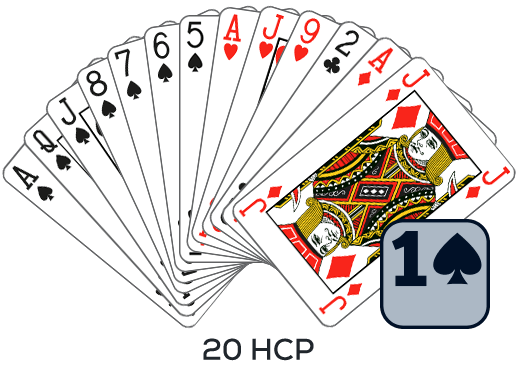
8 playing tricks with Spades as trumps (6 1 1). A
opening will be enough. If your partner passes, it will mean that you did not have game.
With a two-suited hand
Here we talk about two-suiters of at least 5-5. Other two-suited hands (5-4) will be evaluated in HCP.
In view of the very high levels reached by a complete description of a 5-5 two-suiter after a
Avoid this opening with "borderline" two-suited hands. Agree to open at the 1-level with very strong hands and keep in mind that not opening
In view of the very high levels reached by a complete description of a 5-5 two-suiter after a
opening, you will choose the latter only with a maximum of 2-2.5 losers.
Avoid this opening with "borderline" two-suited hands. Agree to open at the 1-level with very strong hands and keep in mind that not opening
doesn't necessarily limit the value of a two-suited hand.
Example:
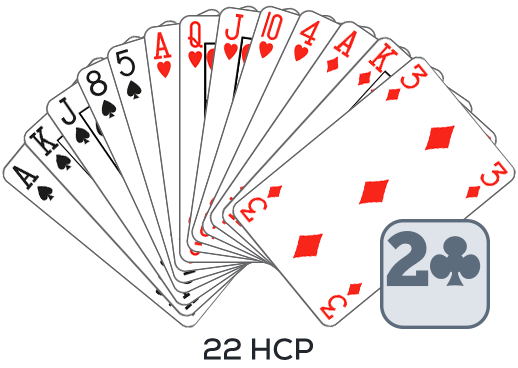
This hand is really worth a
opening since with 2 cover cards opposite (the Queen of Spades and the Queen of Diamonds for instance), slam is possible.
The 2NT opening
The criteria are simple. They are exactly the same as for a
opening: a balanced hand. Only the opening range varies. You need 20-22 points to open
.
The Blackwood 4NT bid
Before declaring a slam, you have to follow 2 key rules:
1) Have enough points for the chances of success of the slam to be good (As a reminder, at least 33 points for a small slam and 37 points for a grand slam.).
2) Check that you are not missing 2 aces because otherwise the slam will not be successful.
To check this, a particular convention called Blackwood 4NT has been invented. It consists of bidding
The responses are very simple:
5: 0 Aces
5: 1 Ace
5: 2 Aces
5: 3 Aces.
Then all you need to do is compare with his number of Aces to decide to try for slam or not.
1) Have enough points for the chances of success of the slam to be good (As a reminder, at least 33 points for a small slam and 37 points for a grand slam.).
2) Check that you are not missing 2 aces because otherwise the slam will not be successful.
To check this, a particular convention called Blackwood 4NT has been invented. It consists of bidding
and asks the partner to divulge the number of aces he has.
The responses are very simple:
5: 0 Aces
5: 1 Ace
5: 2 Aces
5: 3 Aces.
Then all you need to do is compare with his number of Aces to decide to try for slam or not.
Two clarifications:
- Use Blackwood only after a fit is found because to play a slam in NT, you need 33 points. You can’t, therefore, be missing two aces.
- Some use a more elaborate version of Blackwood called Blackwood with 30/41 responses:
5: 0 or 3 Aces
5: 1 or 4 Aces
5: 2 Aces without the King of Trumps
5: 2 Aces with the King of Trumps.
This is only used by more experienced players.
- Use Blackwood only after a fit is found because to play a slam in NT, you need 33 points. You can’t, therefore, be missing two aces.
- Some use a more elaborate version of Blackwood called Blackwood with 30/41 responses:
5: 0 or 3 Aces
5: 1 or 4 Aces
5: 2 Aces without the King of Trumps
5: 2 Aces with the King of Trumps.
This is only used by more experienced players.