The first bids
The auction
As mentioned in the first chapter, the game is made up of two phases. The first is the auction. To set the contract, you have to commit to making more than half of the tricks: at least 7 (out of 13).
To evaluate the strength of a hand, a new concept is introduced: high-card points (HCP).
Ace
To evaluate the strength of a hand, a new concept is introduced: high-card points (HCP).
Ace
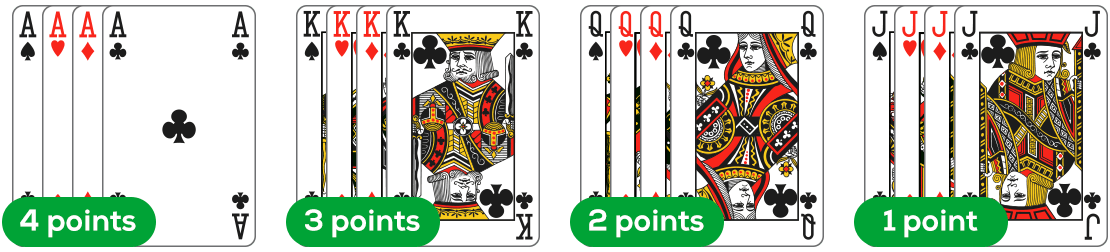
These values are virtual. They are only used for hand evaluation.
There are 40 HCP in total, i.e. 10 per player and 20 per side on average.
Statistically, the side with the most HCP will take the highest number of tricks.
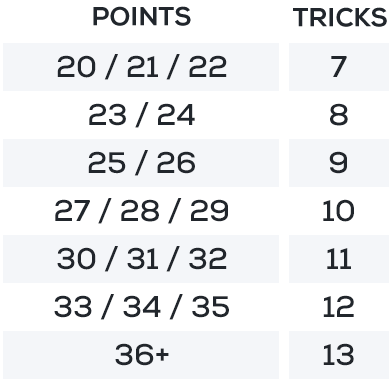
Here is a table showing the number of points held by the stronger side and the number of tricks they will have to take:
Statistically, the side with the most HCP will take the highest number of tricks.
Here is a table showing the number of points held by the stronger side and the number of tricks they will have to take:
The auction is a process which starts with the dealer in a clockwise direction, each player getting his turn to bid. To make a first bid, i.e. to name a contract, the dealer (a role which moves on to the next person for each new deal) must have 12 HCP.
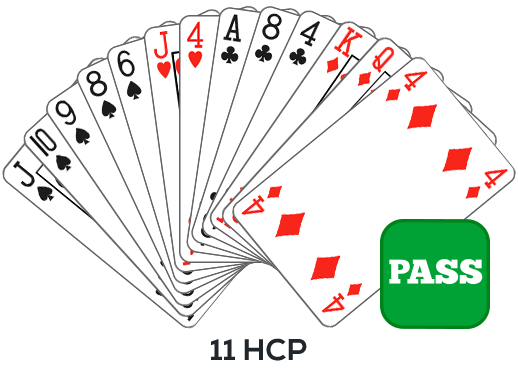
If he has 11 HCP or fewer, he says "pass" and the next player bids. One possible opening bid is 1NT, which usually shows 15-17 HCP and a balanced hand (at least 2 cards in each suit).
If he has 11 HCP or fewer, he says "pass" and the next player bids. One possible opening bid is 1NT, which usually shows 15-17 HCP and a balanced hand (at least 2 cards in each suit).
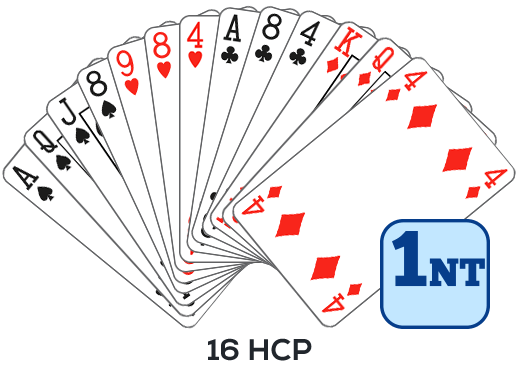
Don't try to find a link with the number of points statistically needed by a side to make a contract: there isn’t one!
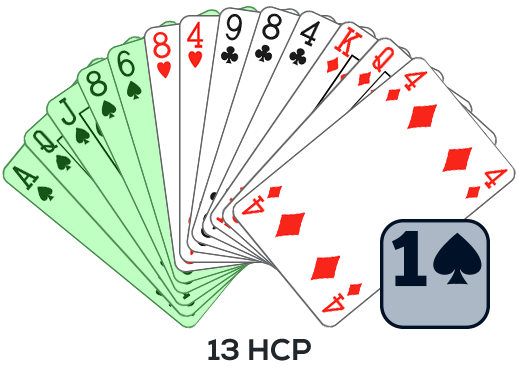
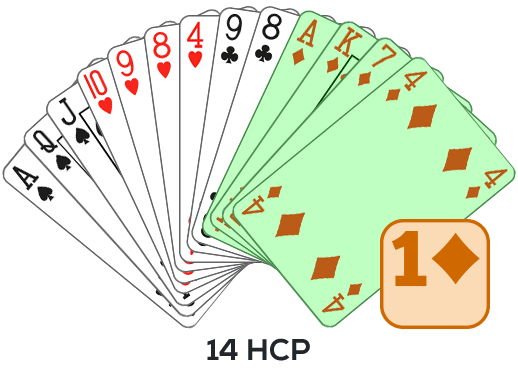
Otherwise, he will open his longest suit. (Please note that if you play a 5-card major system, you need 5 cards to open a major. Otherwise, you open your longer minor.)
Otherwise, he will open his longest suit. (Please note that if you play a 5-card major system, you need 5 cards to open a major. Otherwise, you open your longer minor.)
Hand evaluation
Evaluating the strength of a hand is subjective.
Its value depends on HCP and long suits.
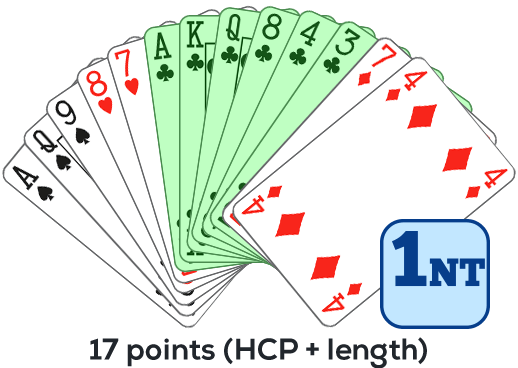
In NT, having a long and solid suit is an advantage.
You count 1 point for the fifth card of a solid suit and 1 extra point per card beyond the fifth card.
These length points are added to the HCP.
Its value depends on HCP and long suits.
In NT, having a long and solid suit is an advantage.
You count 1 point for the fifth card of a solid suit and 1 extra point per card beyond the fifth card.
These length points are added to the HCP.
Hand evaluation in trump contracts
To play in a trump contract, you have to find a fit. Having a fit means that the players of the pair hold 8 cards between them in a suit. This way, opponents only have 5 cards in it and the trump suit will be a significant advantage.
As soon as a fit is found, you can count points for potential ruffs.
These possible ruffs are the short suits and the trumps held in addition to the 8-card fit.
These distribution points are added to the HCP. You count:
- 1 point for a doubleton (except if it includes the Queen or Jack)
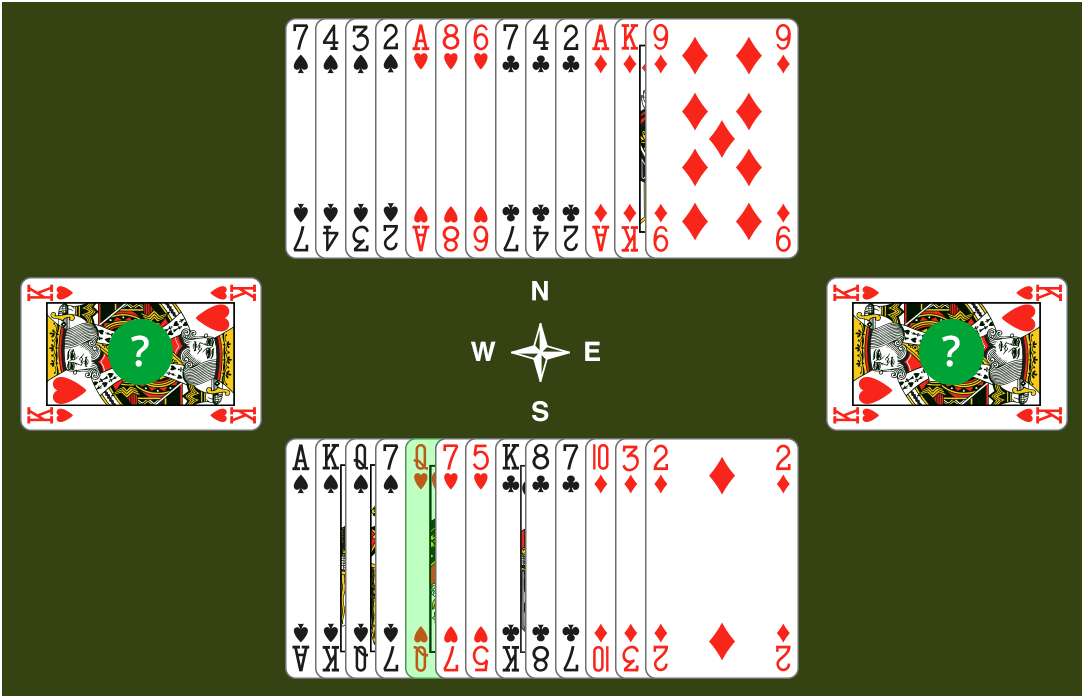
If your partner has promised 5 cards in Hearts, you can add 1 point for the doubleton spade with the hand below:
As soon as a fit is found, you can count points for potential ruffs.
These possible ruffs are the short suits and the trumps held in addition to the 8-card fit.
These distribution points are added to the HCP. You count:
- 1 point for a doubleton (except if it includes the Queen or Jack)
If your partner has promised 5 cards in Hearts, you can add 1 point for the doubleton spade with the hand below:
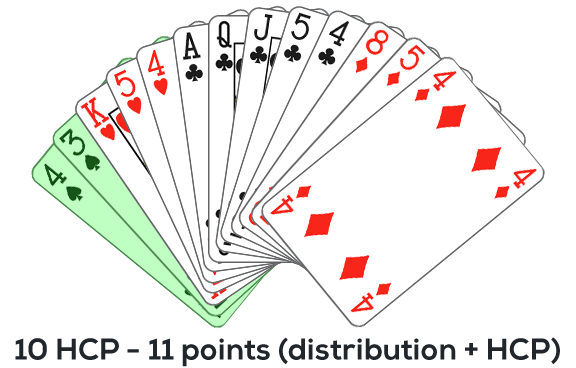
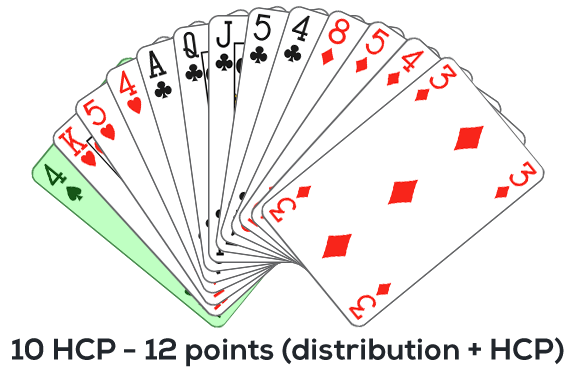
- 2 points for a singleton (except for a stiff Queen or King)
If your partner has promised 5 cards in Hearts, you can add 2 points for the singleton spade with the hand below:
If your partner has promised 5 cards in Hearts, you can add 2 points for the singleton spade with the hand below:
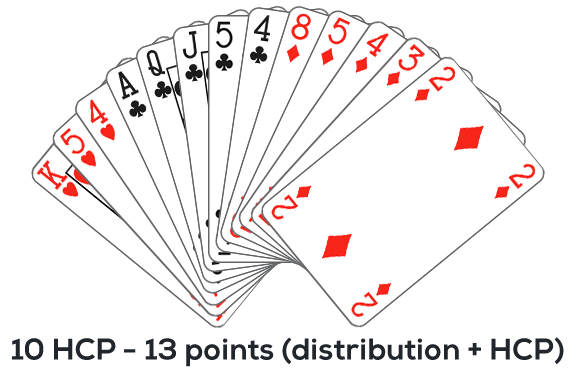
- 3 points for a void
If your partner has promised 5 cards in Hearts, you can add 3 points for the spade void with the hand below:
If your partner has promised 5 cards in Hearts, you can add 3 points for the spade void with the hand below:
- 1 point for an extra trump (the 9th trump held by the side).
If your partner has promised 5 cards in Hearts, you can add 1 point for the ninth trump with the hand below (plus 1 point for each doubleton):
If your partner has promised 5 cards in Hearts, you can add 1 point for the ninth trump with the hand below (plus 1 point for each doubleton):
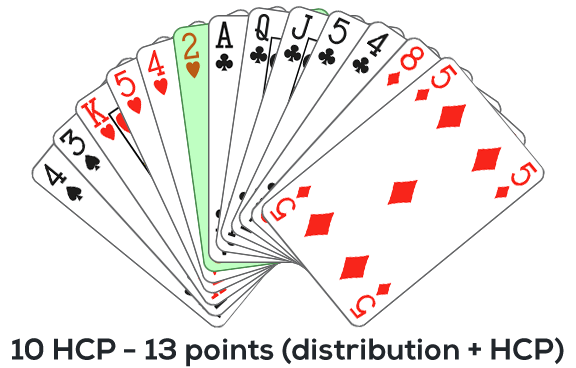
25 HCP or 26-27 points (distribution + HCP) are necessary to look for game (4H or 4S) in a major suit.
Please note that other criteria are taken into account in hand evaluation.
Here are a few factors that will lead you to reevaluate your hand:
- The location of honours in long suits.
- The presence of aces.
- Intermediate cards (10, 9 and 8).
Please note that other criteria are taken into account in hand evaluation.
Here are a few factors that will lead you to reevaluate your hand:
- The location of honours in long suits.
- The presence of aces.
- Intermediate cards (10, 9 and 8).
Finesses
A type of play when you have the Ace and Queen and the King is missing.
When you have decided to play a specific suit and the King is the only card missing in that suit, your ambition should be to take the trick that is not already certain.
To do so, you will have to try to guess where that honour is.
If you are right, you will take a trick with your Queen. If not, you will fail but you will have given yourself the best chance of succeeding.
When you have decided to play a specific suit and the King is the only card missing in that suit, your ambition should be to take the trick that is not already certain.
To do so, you will have to try to guess where that honour is.
If you are right, you will take a trick with your Queen. If not, you will fail but you will have given yourself the best chance of succeeding.