The first responses
To open, you need at least 12 points. To respond, you need at least 6 points, otherwise you will pass.
Major suit raises
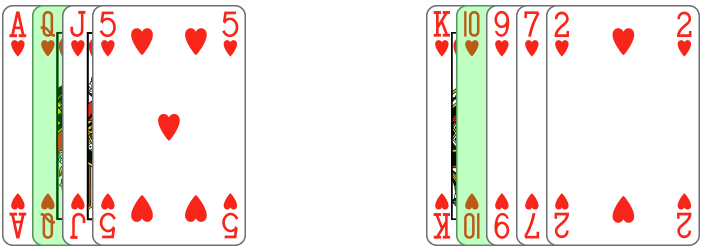
When your partner opens a major (1 or 1), he is promising you at least 5 cards in the suit. You therefore only need 3 cards in the suit to know that it can be your trump suit.
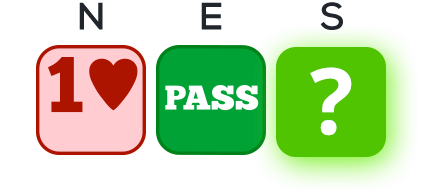
You have to tell your partner that a fit has been found and your point range. Responses will be as follows:
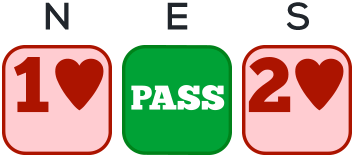
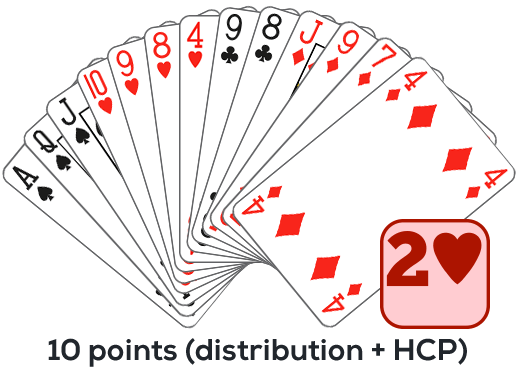
Heart fit (at least 3 cards) and 6-10 points (distribution + HCP)
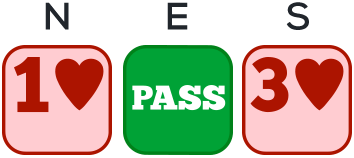
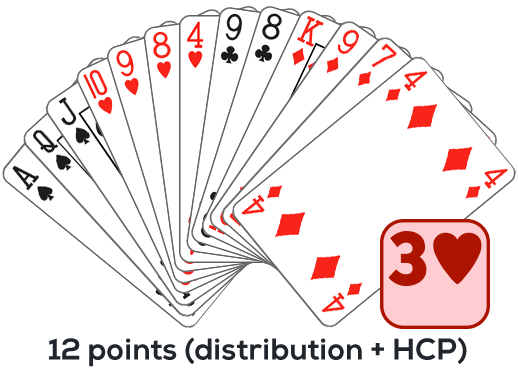
Heart fit (at least 3 cards) and 11-12 points (distribution + HCP)
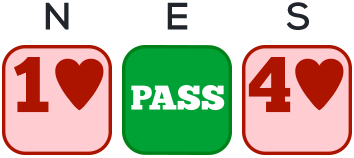
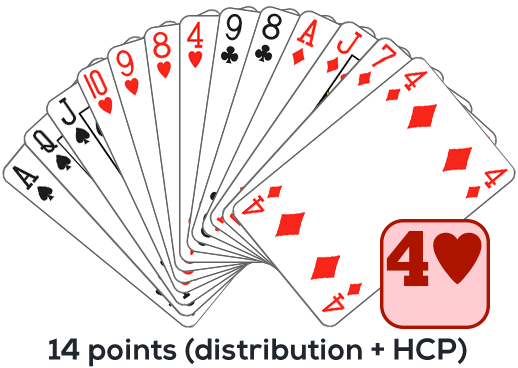
Heart fit (at least 3 cards) and 13-15 points (distribution + HCP)
Responses for stronger hands will be explained later.
Responses without support
When a fit has not been found, the priority is to bid a new suit at the 1-level to look for a fit in another suit.
To make this bid, you only have to hold at least 4 cards in the suit you bid. This bid is ambiguous because it promises at least 6 HCP with no upper limit.
To make this bid, you only have to hold at least 4 cards in the suit you bid. This bid is ambiguous because it promises at least 6 HCP with no upper limit.
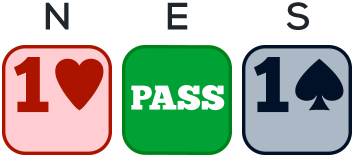
Shows at least 4 cards in Spades.
If you don't have a suit you can bid at the 1-level, you have several choices:
Bid 1NT to show 6-10 points.
Bid a suit at the 2-level: to do so, you must hold 5 cards in that suit and at least 11 points because it makes you bid much higher and obliges the opener to rebid.
Bid 2NT to show 11-12 points (it is an invite to game so that opener can bid 3NT with a maximum hand or pass with a minimum one).
Bid 3NT with 13-15 points: the game that you want to play.
Bid a suit at the 2-level: to do so, you must hold 5 cards in that suit and at least 11 points because it makes you bid much higher and obliges the opener to rebid.
Bid 2NT to show 11-12 points (it is an invite to game so that opener can bid 3NT with a maximum hand or pass with a minimum one).
Bid 3NT with 13-15 points: the game that you want to play.
Ruffing in the short hand
In a trump contract, you can take ruffs but all are not equally effective.
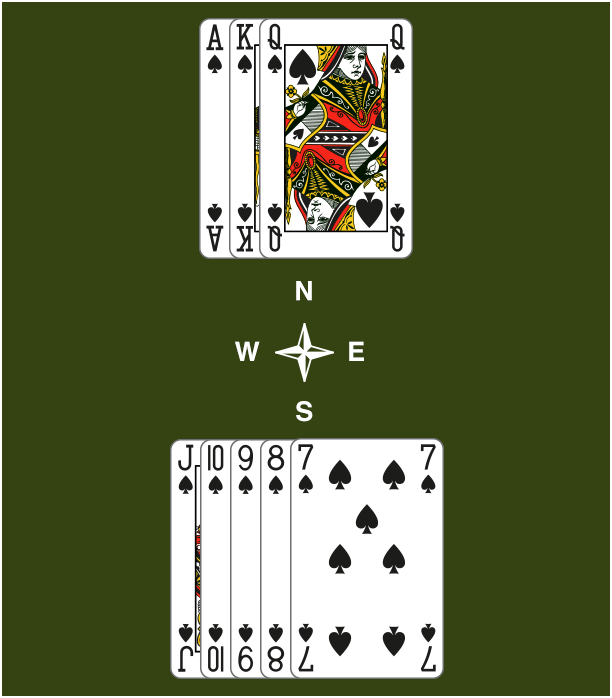
For instance, if you are playing with Spades as trumps, imagine that South holds J 10 9 8 7 of Spades and North holds A K Q of Spades.
For instance, if you are playing with Spades as trumps, imagine that South holds J 10 9 8 7 of Spades and North holds A K Q of Spades.
If you ruff twice in South and then you draw trumps, you make two ruffs (the 7 and 8 of Spades) and you take 3 tricks (the A K Q and J 10 9 of Spades being played together on the same tricks.)
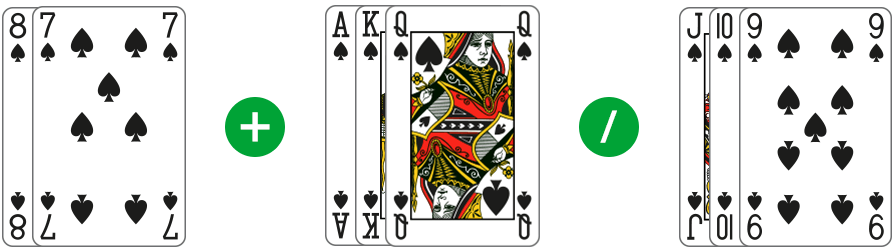
2 + 3
If you ruff twice in North and then you draw trumps, you make two ruffs (the King and Queen of Spades) and you take 5 spade tricks (spade J 10 9 8 7).
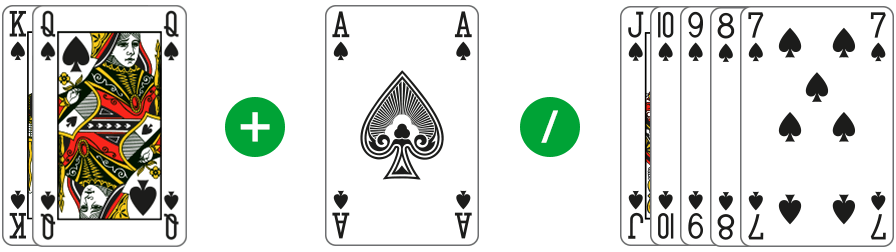
2 + 5
In both cases, you take two ruffs but the ones taken with the long trump hand don't gain you anything because you were already certain to win these tricks.
Conversely, ruffing in the short hand doesn't impact your trump length and results in extra tricks.
Conversely, ruffing in the short hand doesn't impact your trump length and results in extra tricks.
Top of a sequence and broken sequence leads
In NT, you need 3 honours to have a sequence, possibly 2 if other important cards in the suit make up for the missing third one.
A complete sequence: At least 3 consecutive cards.
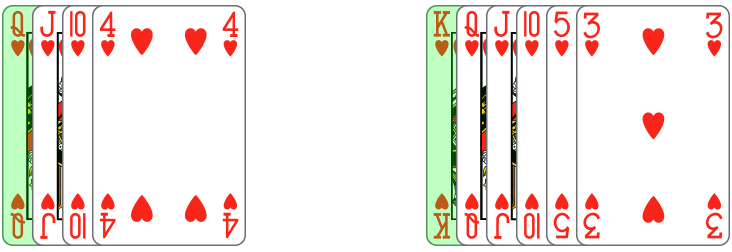
An incomplete sequence: The first, second and fourth cards of a series.
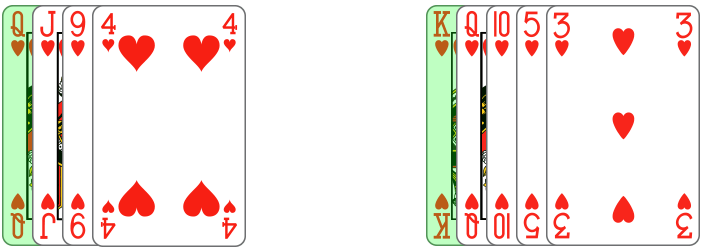
A broken sequence: A sequence of 2 cards where a higher honour makes up for the missing third card.