Overcalling with a double
Traditionally, a double shows that you think you can defeat the opponents' contract.
That being said, in modern bridge, we soon realised that in certain circumstances, it is very rare to be able to double the opponents. For instance, when they are only at the 1-level or they support each other at a low level.
Its meaning has therefore changed to representing the suits which have not yet been bid.
This is typically what happens after the opponents open at the 1-level. Double will therefore become a very specific bid called a "take-out double".
It shows a hand with opening strength, at least 12 points, without any long suit to bid and with at least 3 cards in each unbid suit.
It shows your partner that you have enough strength to go for a contract but you don't know which suit to choose out of the ones that remain.
It is important for your partner not to pass this double and to bid his longest suit.
The stronger your hand is, the more you can go against the required theoretical distribution. We even consider that you can double from 18 points upwards whatever your distribution is.
That being said, in modern bridge, we soon realised that in certain circumstances, it is very rare to be able to double the opponents. For instance, when they are only at the 1-level or they support each other at a low level.
Its meaning has therefore changed to representing the suits which have not yet been bid.
This is typically what happens after the opponents open at the 1-level. Double will therefore become a very specific bid called a "take-out double".
It shows a hand with opening strength, at least 12 points, without any long suit to bid and with at least 3 cards in each unbid suit.
It shows your partner that you have enough strength to go for a contract but you don't know which suit to choose out of the ones that remain.
It is important for your partner not to pass this double and to bid his longest suit.
The stronger your hand is, the more you can go against the required theoretical distribution. We even consider that you can double from 18 points upwards whatever your distribution is.
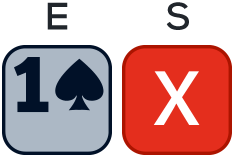
Example: Over the
opening, you will overcall with a X if you have the hand below:
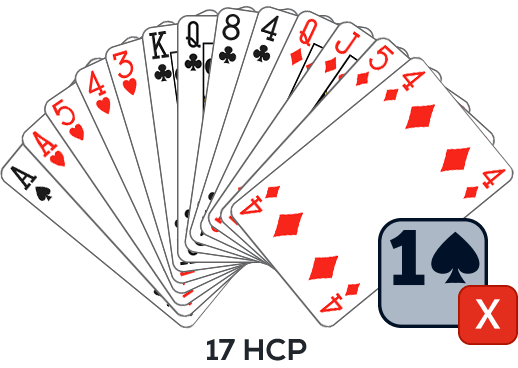
The partner will bid his long suit and you will immediately find your trump suit. It is much less dangerous than bidding a suit by yourself at random.
Responses to take-out double
The doubler's partner will try both to find the best trump suit (his longest suit) and to show his strength by choosing the appropriate level.
For example, after the following auction, he will respond with at least 4 cards in Spades:
with fewer than 8 points,
with 8-10 points,
with 11-12 points,
with 13+ points.
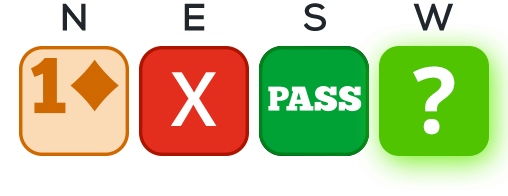
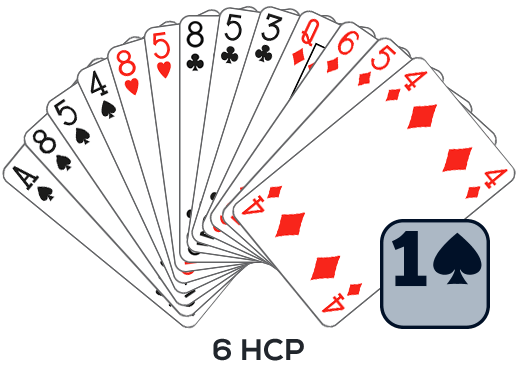
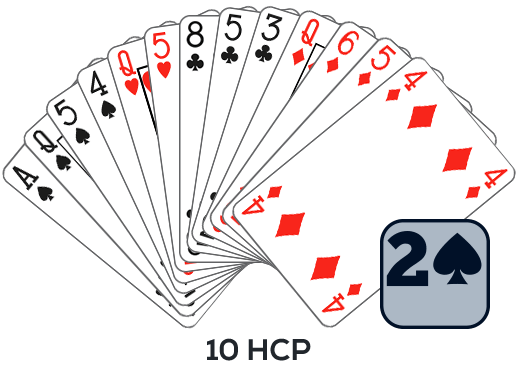
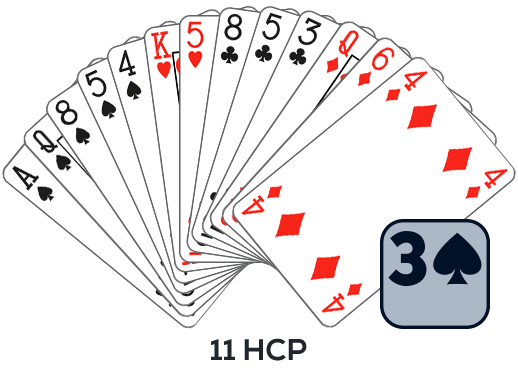
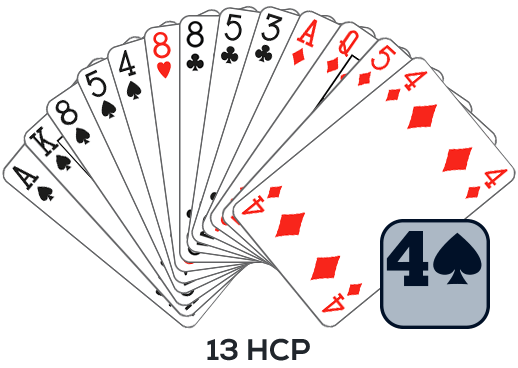
As your partner has promised at least 3 cards in Spades in theory, you will be able to count points for your distribution when you have 5 cards in Spades. You will therefore be able to bid
With no suit to bid, he may be able to bid NT:
or
, sometimes with weaker hands (i.e. fewer points) but with 5 spades and a singleton or 6 cards in Spades for instance.
With no suit to bid, he may be able to bid NT:
with 7-10 points
with 11 points
with at least 12 points
Cashing top honours or finessing
Look at this example to find out more about the limits of the finesse:
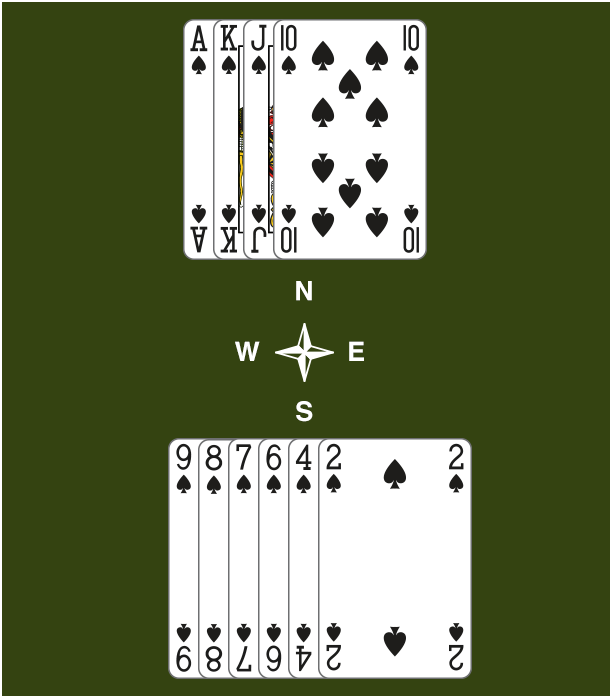
Should you finesse against the missing Queen?
Of course not! Why?
Because you have 10 cards in the suit. If it splits 2-1 between the opponents' hands, you don't need to finesse as the Queen will be played under the Ace or the King. If it splits 3-0, either the Queen is third with West and East will discard on the first round, which will enable you to take the "marked" finesse on the next round, or the Queen is third with East and when West discards, you will know for certain that it is not possible to finesse to catch the Queen.
When an honour is missing and you decide not to finesse, this manoeuvre is called "cashing top honours". Obviously, the more cards you have in the suit, the more you will need to cash top honours.
There is a rule to determine whether you have to cash top honours or finesse: the "7-9-11" rule.
Of course not! Why?
Because you have 10 cards in the suit. If it splits 2-1 between the opponents' hands, you don't need to finesse as the Queen will be played under the Ace or the King. If it splits 3-0, either the Queen is third with West and East will discard on the first round, which will enable you to take the "marked" finesse on the next round, or the Queen is third with East and when West discards, you will know for certain that it is not possible to finesse to catch the Queen.
When an honour is missing and you decide not to finesse, this manoeuvre is called "cashing top honours". Obviously, the more cards you have in the suit, the more you will need to cash top honours.
There is a rule to determine whether you have to cash top honours or finesse: the "7-9-11" rule.
This means that:
- If the Jack is missing, don't finesse against this honour when your side has at least 7 cards.
- If the Queen is missing, don't finesse against this honour when your side has at least 9 cards.
- If the King is missing, don't finesse against this honour when your side has at least 11 cards.
- If the Jack is missing, don't finesse against this honour when your side has at least 7 cards.
- If the Queen is missing, don't finesse against this honour when your side has at least 9 cards.
- If the King is missing, don't finesse against this honour when your side has at least 11 cards.
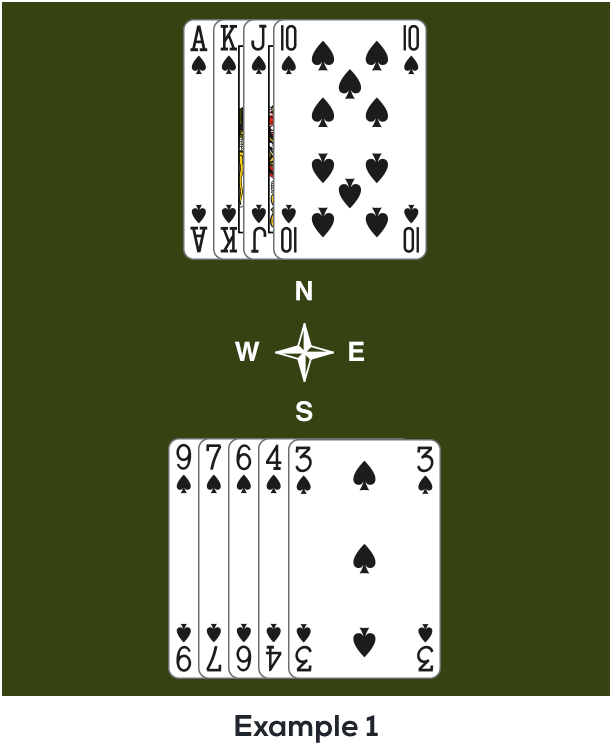
In the first example, you have 9 cards in Spades. There are 4 left. The rule says that from 9 cards, you should not finesse against the Queen anymore. Start by playing the Ace. If everyone follows suit, statistically you will have more chances to pick up the Queen by playing the King on the second round than by playing low to your Jack. You should therefore cash top honours.
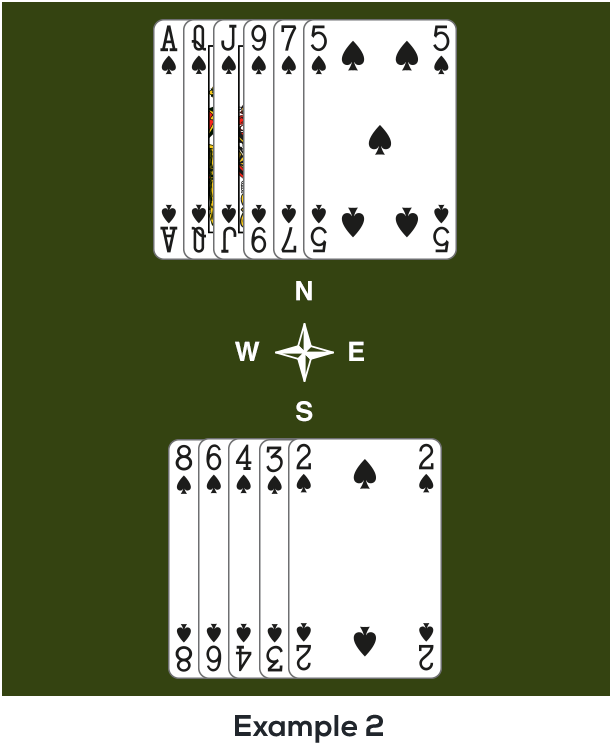
In the second example, you have 11 cards in the suit, which leaves only 2 cards with the opponents. Play as if the suit splits well between the two opponents and cash top honours. (With only 10 cards between you and your partner, you would have had to finesse against the King.)
In the second example, you have 11 cards in the suit, which leaves only 2 cards with the opponents. Play as if the suit splits well between the two opponents and cash top honours. (With only 10 cards between you and your partner, you would have had to finesse against the King.)